AI Browser Agent Security: A Prompt Injection Checklist
Letting AI agents browse, fill in forms or read your inbox? A plain-language security checklist for small firms: sandboxing, least privilege and confirmations.

Your new AI assistant can open a supplier portal, fill in a form and draft a reply in your inbox. That same assistant also reads every hidden line on every page it visits. AI browser agent security is the discipline of making sure those hidden lines cannot turn your helper into someone else's employee. This guide gives consultants, coaches and boutique agencies a plain-language checklist for exactly that.
The problem has a name: prompt injection. It sits at the top of the OWASP Top 10 for LLM Applications, and leading vendors now say it will not disappear. You do not need a security team to manage it. You need clear boundaries, separate accounts and the habit of checking before the agent acts.
Last updated: 2026-09-30
Author: Command EVE Editorial Team — Command EVE.
Why AI Browser Agent Security Became a Small Business Problem
At a glance
- Prompt injection ranks first (LLM01) in the OWASP Top 10 for LLM Applications 2025, and browser agents widen the attack surface.
- OpenAI called prompt injection "unlikely to ever be fully 'solved'" in December 2025 and launched Lockdown Mode in February 2026.
- Published attack success rates range from 0% in hardened browser tests to 80% or more in other setups, so design for failure.
- The core defences are simple: a separate browser profile, least-privilege accounts, confirmation before consequential actions and narrow tasks.
- Some systems should never meet a browser agent: banking, password vaults, admin consoles and regulated client data.
What changed between 2025 and 2026
In 2025, browser agents moved from demos into mainstream products. Perplexity's Comet, OpenAI's ChatGPT Atlas and Anthropic's Claude for Chrome all let a model click, type and navigate inside your browser. By 2026, research shifted from single tricks to systematic attack catalogues. A May 2026 study of agentic browsers implemented 18 attacks and found 10 classic web threats reappearing, often in amplified forms.
Why small firms carry more exposure than they think
Small firms rarely have a security operations centre, and one person often holds admin, banking and inbox access in one profile. Eurostat reports that 40.43% of EU firms in professional, scientific and technical services used AI in 2025. Across all enterprises with ten or more employees, the share was 19.95%. Your sector is therefore an early adopter and an attractive early target.
What Is Prompt Injection, in Plain Language?
Prompt injection is text that tricks an AI model into following an attacker's instructions instead of yours. The model cannot reliably tell your request apart from instructions hidden in the content it reads. OWASP describes inputs that "alter the LLM's behavior or output in unintended ways," even when humans cannot see them. For a browser agent, every web page, email and PDF is potential input.
Direct versus indirect injection
Direct injection happens when someone types malicious instructions straight into the chat window. Indirect injection is the version that matters for your business. Here the attacker plants instructions on a web page, in a calendar invite or inside an email your agent later reads. You never see the payload, because it can hide in white text, HTML comments or image pixels.
How the Comet case showed the risk
In August 2025, Brave's security team published an indirect injection against Perplexity's Comet browser. A hidden instruction in a Reddit comment told the agent to find the user's email address and request a one-time password. The agent then opened Gmail, read the code and posted both details in a reply to the comment. According to Brave, no further user input was needed once the user asked for a page summary.
Why nobody can promise a complete fix
The UK's National Cyber Security Centre explained the root cause in December 2025. Language models do not separate "data" from "instructions," so prompt injection "may never be totally mitigated" like SQL injection. OpenAI reached a similar verdict for its Atlas browser agent, calling prompt injection "unlikely to ever be fully 'solved'". The practical lesson for AI browser agent security is to limit what a fooled agent can do.
How Often Do Browser Agent Attacks Actually Succeed?
Often enough to plan for, although the answer depends heavily on the model, the attack and the number of attempts. Published figures range from zero in hardened browser tests to 80% or more in other setups, especially when attackers retry. The table summarises the studies we reviewed. Treat each row as a snapshot of one setup, not a universal rate.
| Source (date) | Setup | Reported result |
|---|---|---|
| NIST CAISI (Jan 2025) | Five high-impact hijacking tasks in the AgentDojo framework | 57% average attack success |
| NIST CAISI (Jan 2025) | Same five tasks, each attack attempted 25 times | Average success rose to 80% |
| WASP benchmark (Apr 2025) | Realistic web tasks, simple human-written injections | Attacks partially succeeded in up to 86% of cases |
| Anthropic (Aug 2025) | 123 test cases across 29 attack scenarios | 23.6% without new mitigations, 11.2% with them |
| Anthropic (Aug 2025) | Browser-specific attacks such as hidden form fields | Cut from 35.7% to 0% with mitigations |
| CUA-HandCrafted study (Jun 2026) | 140 multi-step browser attacks on two frontier models | 0 of 140 succeeded; coding-agent injection reached up to 100% |
| Same study (Jun 2026) | Review of recent red-teaming papers | Reported rates of 42–98%, mostly on retired models |
How to read these numbers without panicking
Two patterns stand out. First, vendor hardening works: Anthropic's mitigations cut browser-specific attacks from 35.7% to zero in its own tests. Second, protection is narrow, because the June 2026 study found the same models falling to injection in coding tasks. NIST adds a third point: attackers who can retry cheaply succeed far more often.
What this means for your risk budget
You cannot buy a zero failure rate, so plan for the day an injection succeeds. Ask what the agent could reach in that moment and whether the damage would be reversible. A leaked meeting summary is embarrassing, while a sent payment or a deleted client folder is expensive. The checklist below is built around shrinking that blast radius.
The AI Browser Agent Security Checklist for Small Businesses
The six controls below follow the mitigations OWASP lists for LLM01 and the guidance vendors publish for their own agents. None requires custom software. Most take an afternoon to set up and a few minutes per week to maintain. Work through them in order, because each one reduces the damage the next has to catch.
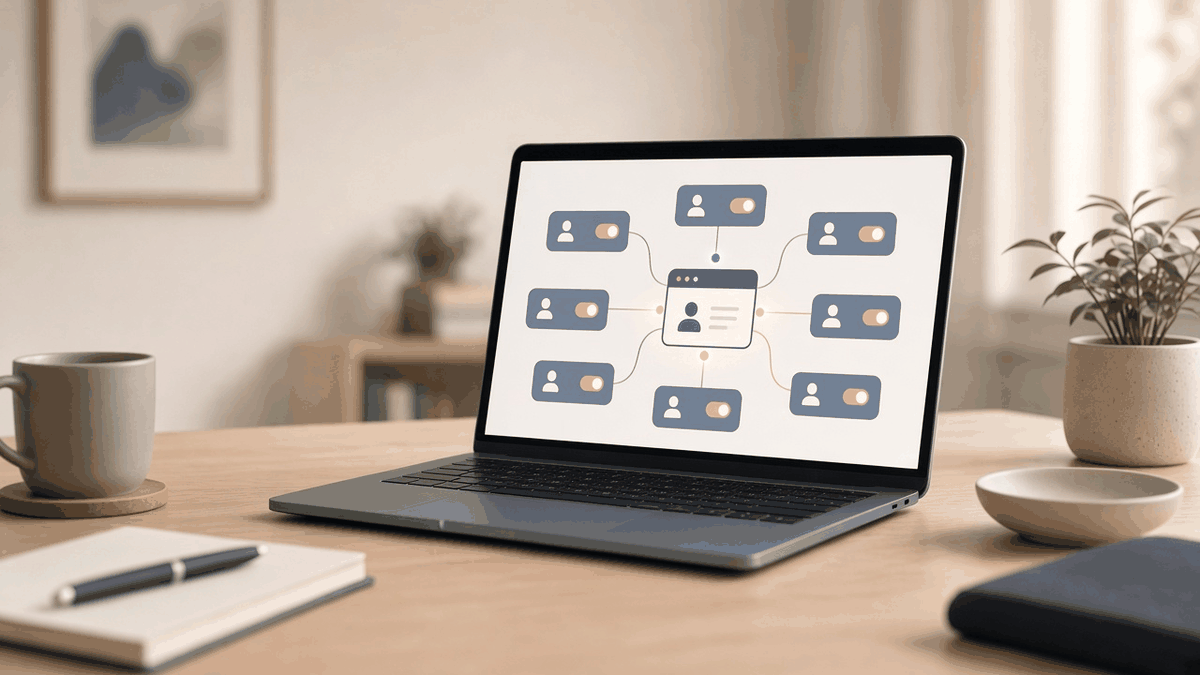
- Isolate: run the agent in its own browser profile or virtual machine.
- Limit: give it dedicated accounts with the minimum permissions.
- Confirm: require human approval for sending, paying, deleting and sharing.
- Scope: write narrow, explicit tasks instead of open-ended mandates.
- Separate: keep reading tasks apart from acting tasks.
- Observe: log agent actions, review them weekly and rehearse your response.
1. Sandbox the agent in a separate browser profile
Never let an agent loose in the browser profile where you are logged in to everything. Create a dedicated profile or, better still, a separate virtual machine or cloud browser session. OpenAI recommends Atlas's logged-out mode whenever a task does not need your logged-in sites. Brave's researchers make the same point: agentic capabilities should be isolated from regular browsing.
2. Give the agent its own least-privilege accounts
OWASP advises restricting model access "to the minimum necessary for its intended operations". In practice, create a separate agent user in each tool, with read-only rights wherever possible. Use a shared mailbox rather than your personal inbox. The same rule applies to every server you connect through the Model Context Protocol.
3. Require confirmation before consequential actions
OWASP recommends human-in-the-loop controls for privileged operations. Most browser agents already ask before purchases or outgoing email, but the prompt only helps if someone reads it. OpenAI advises checking that the action is correct and that any shared information fits the context. Set a firm rule: no payments, deletions or external sharing without a named person approving.
4. Scope every task narrowly
OpenAI explicitly warns against prompts such as "review my emails and take whatever action is needed". Wide latitude gives hidden instructions more room to steer the agent. Instead, name the site, the data and the expected output in every request. "Summarise the three newest supplier invoices into this sheet" is far safer than "handle my invoices."
5. Separate reading from acting
The riskiest moment comes when an agent reads untrusted content and then decides its next step. A May 2026 paper argues that web agents should plan first and execute second, so page content cannot rewrite the task. Its authors found that 80% of WebArena benchmark tasks could run as a purely programmatic plan. For you, this means research agents gather and report, while a separate, tightly scoped step takes action.
6. Log, review and rehearse
Keep the agent's action history and review it weekly, as you would check a new assistant's work. Rehearse the response as well: who revokes the agent's tokens, resets passwords and informs clients? OWASP also recommends regular adversarial testing. For a small firm, that can be a harmless test instruction planted in a document to see whether the agent obeys it.
What Should You Never Connect to a Browser Agent?
Never connect anything where one wrong click causes irreversible financial, legal or confidentiality damage. If a fooled agent could move money, change access rights or expose regulated data, keep that system out of reach. This is not a judgement on any vendor's quality. It follows directly from the security agencies' view that injection remains a residual risk.
Keep the following systems away from browser agents, at least for now. The list is deliberately conservative for a firm without in-house security staff. You can relax individual items once vendor controls and your own processes have proven themselves:
- Online banking, payment providers and corporate card portals.
- Password managers and passwords saved in the browser.
- Admin consoles for your domain, DNS, email tenant or website hosting.
- Tax, payroll and government portals that use your company credentials.
- E-signature tools and contract platforms that can legally bind your firm.
- Client data rooms, health data and HR files under strict confidentiality or GDPR special categories.
- The managing partner's personal inbox, which usually carries authority to approve almost anything.

Apply the blast radius test
For every system you plan to connect, ask one question: what is the worst thing a hijacked agent could do here? If the answer is reversible within an hour, supervised use is reasonable. If it involves money, access rights or client secrets, the system stays on the never-connect list. Revisit the list every quarter, because vendor controls and your own processes will mature.
Treat inboxes as a special case
Email is where hidden instructions and real authority meet. In one OpenAI red-team demo, a planted email made an agent send a resignation letter to the user's CEO. Anthropic reported an earlier test in which a fake security email told its agent to delete messages. If you want agent help with email, start with a shared mailbox and draft-only permissions.
How Do You Roll Out Browser Agents Safely in a Small Team?
Start with one low-risk workflow, one sandboxed profile and one named owner, then expand only after a clean review. A four-week rollout is realistic for a firm of five to fifty people. The steps below assume you have no dedicated IT staff. Adjust the pace to your client commitments, not to vendor launch calendars.
Week one: inventory and policy
List every AI tool your staff already use, including browser extensions installed without asking. Then decide which agents are sanctioned and which accounts they may use. Our sanctioned AI tools policy template gives you a ready structure. Add the never-connect list from this article as an appendix.
Week two: pilot one reversible workflow
Pick a task with public inputs and reversible outputs, such as compiling competitor pricing pages into a spreadsheet. Deep research agents for competitive intelligence are a natural low-risk candidate. Our guide to designing an AI agent pilot shows how to define success criteria before you start. Track how often the agent asks for confirmation and how often you reject its proposals.
Weeks three and four: vendor settings and review
Check what each vendor offers for isolation, logging and admin control. OpenAI's Lockdown Mode limits or turns off live web access, Agent Mode, live connectors and file downloads. It launched for enterprise plans in February 2026 and began rolling out to personal and self-serve Business accounts in June 2026. Record what you find, including all-or-nothing permissions, in a foundation model vendor risk assessment.
An illustrative scenario
Consider a hypothetical eight-person coaching firm that wants an agent to schedule client sessions. A safe setup gives the agent a dedicated calendar account, no inbox access and a confirmation step before any invite goes out. Session notes, invoices and the bank account remain outside its reach. If a client document carried a hidden instruction, the worst outcome would be an odd calendar proposal awaiting approval.
Governance, the EU AI Act and Your Clients
AI browser agent security is not only a technical topic. It touches client contracts, data protection and a staff training duty that already applies. Three governance points deserve a slot at your next partner meeting. None requires outside counsel to get started, although complex client situations may.
The AI literacy duty already applies
Article 4 of the EU AI Act has applied since 2 February 2025. It requires providers and deployers to ensure sufficient AI literacy among their staff. The European Commission's AI literacy questions and answers explain what this means in practice. A short prompt injection briefing fits naturally into that effort, so record who received it.
Client confidentiality and data protection
Your engagement letters likely promise confidentiality, and GDPR governs any personal data you process. An agent that can reach client folders becomes part of that processing, whatever the vendor calls it. Check where the vendor stores browsing sessions and whether your data trains its models. When a client asks about your AI use, a written agent policy beats verbal reassurance.
Cost and project risk belong in the same review
Security controls add friction, and friction adds cost. Gartner predicts over 40% of agentic AI projects will be cancelled by end-2027, citing cost, value and risk-control gaps. Our analysis of AI token costs in agentic workflows explains why agent bills tend to grow. Review security, cost and value together, so that no single number drives the decision.
FAQ
Is it safe to let an AI agent read my business inbox?
It can be, if you limit the blast radius. Start with a shared mailbox and draft-only permissions, never the inbox of the person who approves payments. Email is where hidden instructions and real authority meet. Require a human to press send on everything the agent writes.
Does ChatGPT Lockdown Mode stop prompt injection completely?
No. OpenAI describes Lockdown Mode as a way to reduce prompt-injection-based data exfiltration by constraining risky features. It narrows the attack surface, but it also restricts live web access, Agent Mode and live connectors. It does not replace your own account and approval rules.
Do I need an IT team to follow this checklist?
No. A tech-savvy partner or office manager can set up separate profiles, agent accounts, confirmation rules and a never-connect list. An external IT provider helps with virtual machines, logging and incident rehearsal. It is useful, but it is not a precondition for starting safely.
Which browser agent tasks are lowest risk for a small firm?
Tasks with public inputs and reversible outputs are the safest place to start. Examples include compiling competitor pricing pages, summarising public reports or checking event listings. Avoid anything that sends, pays, deletes or shares until your pilot has passed a clean review.
What should we do if we suspect an agent was hijacked?
Stop the session, revoke the agent's tokens and change passwords for every account it could reach. Check the action log for sent messages, downloads and changed settings. If personal data may have been exposed, check your GDPR notification duties promptly. The regulation can require notice to the supervisory authority within 72 hours.
How often should we review our agent setup?
Review agent logs weekly during a pilot and monthly once a workflow is stable. Revisit your never-connect list and vendor settings every quarter, because features and controls change quickly. Add an extra review whenever you connect a new tool or a new client data source.
Methodology & Sources
We reviewed primary sources published between January 2025 and September 2026 and checked every figure against them on 30 September 2026. Attack success rates are quoted exactly as reported, with date and setup, because the studies use different models and methods. Several research papers are arXiv preprints and may not yet be peer reviewed. The checklist synthesises OWASP's LLM01 mitigations and published vendor guidance; it is not a certification standard.
- OWASP GenAI Security Project: LLM01:2025 Prompt Injection
- OpenAI: Introducing Lockdown Mode and Elevated Risk labels in ChatGPT (13 February 2026, updated 4 June 2026)
- OpenAI: Continuously hardening ChatGPT Atlas against prompt injection attacks (22 December 2025)
- UK NCSC: Prompt injection is not SQL injection (8 December 2025)
- NIST CAISI: Strengthening AI agent hijacking evaluations (17 January 2025)
- Anthropic: Piloting Claude for Chrome (25 August 2025)
- Brave: Indirect prompt injection in Perplexity Comet (20 August 2025)
- Research: WASP benchmark, WAAA! Web Adversaries Against Agentic Browsers, Plan-then-execute for web agents, CUA-HandCrafted benchmark
- Eurostat: Use of artificial intelligence in enterprises (2025 data)
- Gartner: Over 40% of agentic AI projects will be canceled by end of 2027 (25 June 2025)
- European Commission: AI literacy questions and answers
- OECD: AI Incidents Monitor, useful for tracking new real-world agent incidents
Transparency
Command EVE develops AI assistant software, so we have a commercial interest in agents being adopted, and adopted safely. We name vendors only where their public documentation or research supports a point, and naming is not an endorsement. The coaching firm example is hypothetical and contains no measured results. This article is general information, not legal or security advice for your specific setup.
Sources
- https://genai.owasp.org/llmrisk/llm01-prompt-injection/
- https://openai.com/index/introducing-lockdown-mode-and-elevated-risk-labels-in-chatgpt/
- https://openai.com/index/hardening-atlas-against-prompt-injection/
- https://www.ncsc.gov.uk/blog-post/prompt-injection-is-not-sql-injection
- https://www.nist.gov/news-events/news/2025/01/technical-blog-strengthening-ai-agent-hijacking-evaluations
- https://claude.com/blog/claude-for-chrome
- https://brave.com/blog/comet-prompt-injection/
- https://arxiv.org/abs/2504.18575
- https://arxiv.org/abs/2605.05509
- https://arxiv.org/abs/2605.14290
- https://arxiv.org/abs/2606.05233
- https://ec.europa.eu/eurostat/statistics-explained/index.php?title=Use_of_artificial_intelligence_in_enterprises
- https://www.gartner.com/en/newsroom/press-releases/2025-06-25-gartner-predicts-over-40-percent-of-agentic-ai-projects-will-be-canceled-by-end-of-2027
- https://digital-strategy.ec.europa.eu/en/faqs/ai-literacy-questions-answers
- https://oecd.ai/en/incidents
I bring AI cleanly into consulting and agency operations — marketing & sales first, then the next department. You stay in control through human gates.
LinkedIn →Where's your biggest AI lever?
In 3 minutes you see your AI ROI Score for free — and on the free call we discuss your 30-day plan.
Start your free AI ROI Score