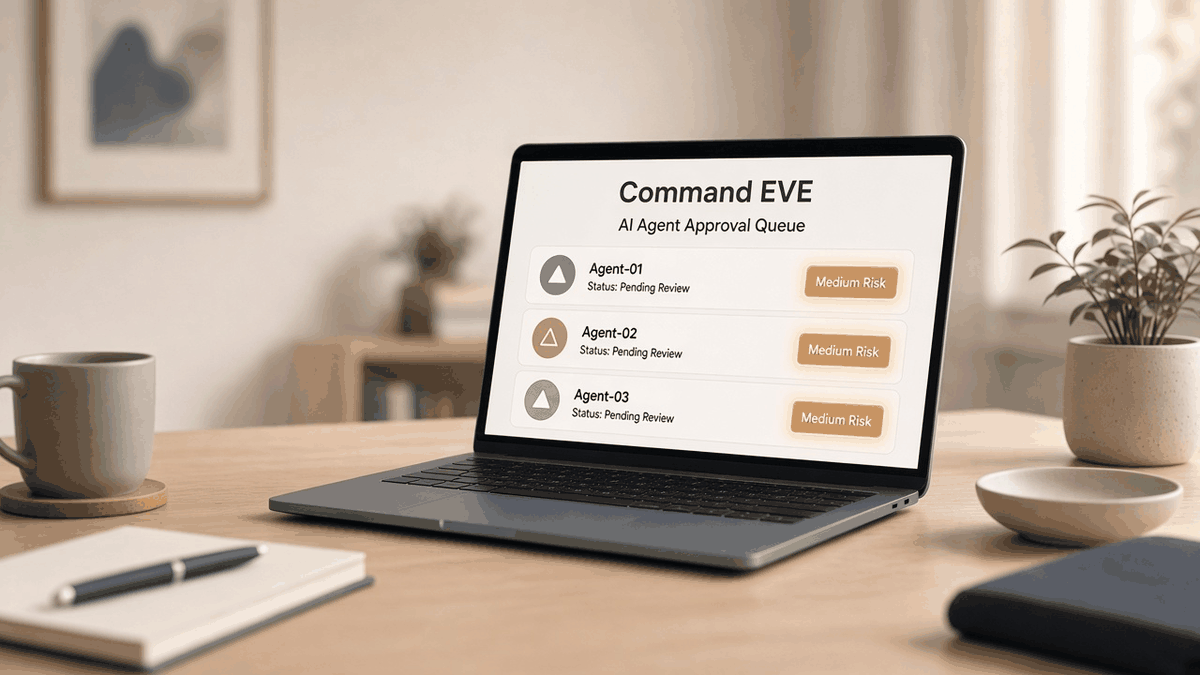
Model Context Protocol (MCP) for SMBs: A 2026 Starter Kit
MCP now sits under Linux Foundation governance. How a 20-person SMB connects Claude, GPT and Gemini to HubSpot and Notion in 2026, and avoids Shadow MCP.


The Model Context Protocol (MCP) stopped being a developer curiosity in 2026. For an SMB of 20 people, that shift matters more than any new model release. MCP lets Claude, GPT and Gemini work inside HubSpot, Notion or Postgres through one standard connector, not custom middleware. This guide gives you a practical starter kit, the numbers behind the hype, and the Shadow MCP risk to control early.
We wrote it for consultancies, coaching practices and boutique agencies that run on a CRM, a wiki and a few databases. You do not need an engineering team to follow it. You do need an owner, a register and the discipline to start read-only.
Last updated: 2026-09-28
Author: Command EVE Editorial Team — Command EVE.
At a Glance: What MCP Means for SMBs in 2026
- MCP is now vendor-neutral infrastructure. Anthropic donated it to the Linux Foundation's Agentic AI Foundation in December 2025.
- One connector serves several assistants. The same server works with Claude, ChatGPT and Gemini, so small firms can skip custom middleware for common tools.
- Start read-only. Connect HubSpot, Notion and a Postgres replica with narrow scopes before any agent may write.
- Shadow MCP is the new Shadow AI. Servers that staff install without approval now appear in OWASP's top-ten list for the protocol.
- Measure one workflow for 30 to 90 days. McKinsey found that no more than 10% of organizations scale agents in any given function.
What Is the Model Context Protocol, in Plain Business Terms?
The Model Context Protocol is an open standard that lets AI assistants connect to business systems in one uniform way. Anthropic introduced it in November 2024, and the major assistants have since adopted it. A system exposes its data and actions once, through an MCP server. Any compatible assistant can then use them, whether your team prefers Claude, ChatGPT or Gemini.
The USB-C analogy, and where it breaks
The protocol is often described as a USB-C port for AI. The analogy holds for plugging in, because one standard socket replaces a drawer of adapters. It breaks on safety, since a USB cable cannot decide to email your client list. A connection can carry both reading and acting, so permissions matter far more than with a cable.
Hosts, clients and servers
Three roles do the work. The host is the app your consultant uses, such as Claude Desktop or ChatGPT. Inside it, an MCP client keeps one connection per server. The server wraps a system like HubSpot and exposes tools, resources and prompt templates the model can call.
Servers run either locally on a laptop or remotely as hosted services. Local servers talk over standard input and output, while remote ones use HTTP with OAuth-based authorization. For a small firm, hosted servers from the software vendor itself are usually the safer default. They inherit the vendor's authentication and audit logs rather than relying on your own scripts.
Why this ends custom middleware for small firms
Before MCP, connecting an assistant to your CRM meant a Zapier chain, a custom GPT action or a freelancer's script. Each integration served one model and broke whenever an API changed. With the protocol, the vendor maintains one server and every compliant assistant can use it. Your job shifts from building plumbing to deciding who may use which pipe.
Why Did MCP Become Enterprise-Grade in 2026?
Two things changed at once: governance and scale. The Model Context Protocol moved to neutral stewardship under the Linux Foundation, and adoption reached a level vendors cannot ignore. For buyers, that combination lowers lock-in risk. It also makes it less likely that the connectors you set up now will be orphaned next year.
Linux Foundation governance changes the risk math
In December 2025, the Linux Foundation announced the Agentic AI Foundation, with MCP as a founding project. Anthropic, Block and OpenAI co-founded it, and platinum members include AWS, Google, Microsoft, Cloudflare and Bloomberg. According to the project's maintainers, the foundation does not dictate technical direction. For you, it means no single model vendor controls the standard your integrations depend on.
Adoption numbers you can actually cite
The official MCP blog reported 97 million monthly SDK downloads and 10,000 active servers at the time of the donation. Server counts vary by registry, and some curated directories list closer to 5,800 vetted servers. Industry trackers also widely cite that roughly 28% of Fortune 500 companies run MCP servers in production. We could not trace that figure to a primary, audited dataset, so treat it as directional.
What the analysts expect next
Gartner predicts that 40% of enterprise applications will feature task-specific AI agents by 2026. That is up from less than 5% in 2025. Most of those agents need a standard way to reach data, and this protocol has become a widely supported route.
The same firm also expects over 40% of agentic AI projects to be canceled by the end of 2027. It cites escalating costs, unclear business value and inadequate risk controls. The lesson for a small firm is simple: connect deliberately, not everywhere at once.
Is the Model Context Protocol Ready for a 20-Person SMB?
Yes, for read-heavy workflows with clear owners, but not yet for unsupervised write access across systems. The protocol, the major assistants and the leading SaaS vendors are mature enough for a pilot. What most small firms lack is not technology but a register, an owner and a review habit. Fix those first, and the technical setup becomes the smaller part of the work.
Where small firms stand today
Eurostat data shows that 20.0% of EU enterprises with ten or more employees used AI in 2025. The gap by size is stark: 17% of small enterprises versus 55% of large ones. The OECD survey of more than 5,000 SMEs found generative AI in use at 31% of them. Yet only 29% of those users apply it in core activities, the area these connectors are built for.
If your team already uses AI but sees little effect on the bottom line, you are not alone. Our analysis of the SMB AI confidence-productivity gap shows the problem is usually missing context, not missing capability. Assistants that cannot see your CRM or project notes produce generic drafts. Standard connectors address that gap without asking staff to copy and paste.
The honest readiness test
A readiness test keeps the pilot honest from the first week. It takes about an hour and needs no technical staff. Answer these five questions in writing before the first connector goes live:
- Who owns each system you plan to connect, by name?
- Which data in it is confidential, personal or client-privileged?
- Are your assistant seats business accounts with admin controls, not personal logins?
- Which single workflow will you measure, and what is its baseline today?
- Who reviews agent actions and logs every week?
If any answer is blank, the gap is organizational, not technical. Personal logins are a common blocker, because they sit outside your admin controls. Close these gaps first, and the rollout becomes far easier to defend to clients.
The Practical Starter Kit: Connecting Claude, GPT and Gemini to Your Stack
The starter kit below assumes a typical 20-person consultancy. It runs HubSpot as its CRM, Notion as wiki and project hub, and Postgres behind a reporting tool. The same pattern applies if you use Pipedrive, Confluence or MySQL instead. What matters is the sequence: one workflow, read-only first, then narrow write access.
Step one: pick one workflow, not one tool
Resist the urge to connect everything in the first week. Choose a workflow that crosses systems and costs senior time, such as preparing a client renewal meeting. That task pulls deal history from HubSpot, project notes from Notion and utilization data from Postgres. Our guide to a six-month-payback AI agent pilot shows how to size and baseline such a workflow.
HubSpot: read first, write later
HubSpot provides an official MCP server, so you do not need a third-party bridge. Connect it with the narrowest scopes your workflow needs, typically read access to contacts, companies and deals. Keep write scopes, such as creating tasks or moving deal stages, for phase two. Log which user authorized the connection, because actions will run under that identity.
Notion: the knowledge layer
Notion runs a hosted MCP server that authenticates through each user's own Notion permissions. That design helps, because the assistant sees only what the consultant could already open. It is also a risk, because over-shared workspaces become over-shared agents. Audit page permissions and archive stale client spaces before you connect anything.
Postgres: read-only roles and views
Databases need the most care, because a general SQL tool can read anything its credentials allow. Create a dedicated read-only role and expose curated views rather than raw tables. Point the server at a replica or reporting copy, never at the production primary. Treat community reference servers as examples rather than hardened products, and review the code before use.
A 30-day rollout sequence
The sequence below fits into one month alongside client work. It assumes one internal owner with roughly half a day per week. Adjust the timing if you must, but keep the order.
- Week 1: Complete the readiness test and create a one-page MCP register.
- Week 1: Standardize on business seats and restrict personal connectors where the admin console allows it.
- Week 2: Connect HubSpot and Notion read-only for three pilot users.
- Week 2: Connect Postgres through a read-only role and curated views on a replica.
- Weeks 3–4: Run the target workflow daily and log time saved, errors and missing data.
- Day 30: Review the logs, decide on write scopes and document that decision.
The table below summarizes how each common system fits into that sequence. Use it as a starting point for your own register, not as a vendor recommendation. Adjust owners to your real team structure.
| System | Typical MCP route | Phase-one scope | Main risk | Suggested owner |
|---|---|---|---|---|
| HubSpot CRM | Vendor-hosted server | Read contacts, companies, deals | Client data exposure via broad scopes | Sales or partner lead |
| Notion wiki | Vendor-hosted server | User's existing page access | Over-shared workspaces | Operations lead |
| Postgres reporting database | Self-hosted server with read-only role | Curated views on a replica | Unrestricted SQL reads | Technical owner or freelancer |
| Google Drive or SharePoint | Native connector or server | Selected shared drives only | Legacy files with personal data | Operations lead |
| Slack or Teams | Native connector or server | Selected project channels | Private client conversations | Managing partner |
| Accounting and payroll | Not connected in phase one | None | Financial and personal data | Finance lead |
What Is Shadow MCP, and Why Should a Small Firm Care?
Shadow MCP means servers that staff install or connect without approval or oversight. The OWASP MCP Top 10 lists shadow servers as a distinct risk, citing weak credentials and permissive defaults. In a small firm, the cause is rarely malice; it is a helpful consultant connecting a personal assistant to a client folder.
How Shadow MCP shows up in a 20-person firm
Desktop assistants make it easy to add local servers through a single configuration file. A consultant might install a community file-system server, a browser tool or a database connector found on GitHub. Each one runs with that person's access and often stores API keys in plain text. None of it appears in your software inventory, and nobody reviews what the server actually does.
OWASP names the consequences: data exposure, a larger attack surface, compliance violations and slower incident response. Malicious or compromised servers add a supply-chain risk on top. Prompt injection makes it worse, because text in a document or email can steer an agent toward tools it should not use. The more servers one person connects, the more paths an injected instruction can take.

Five controls that fit a small team
You do not need an enterprise security platform to contain Shadow MCP. OWASP recommends a central registry, continuous discovery, secure defaults and identity integration. Scaled to a 20-person firm, that translates into five habits. Our sanctioned AI tools policy template gives you the wording for the policy side.
- Keep one approved-servers list in your register, and treat everything else as unapproved.
- Prefer vendor-hosted servers with OAuth over local servers that hold static API keys.
- Use business plans whose admin console lets you restrict or allowlist connectors.
- Ask staff each quarter to show their assistant's connected tools, which takes minutes per person.
- Rotate any API key that ever sat in a local configuration file.
Governance Without an IT Department
Most 20-person firms have no security officer and no platform team. Governance therefore has to live in documents a managing partner can read in ten minutes. Two artifacts carry most of the load: an MCP register and a vendor check. Together they turn good intentions into something you can show a client or auditor.
A one-page MCP register
The register lists every approved server with its owner, scopes, data classes and next review date. Add the assistant accounts allowed to use each server and where its logs are kept. Store it next to your AI tools policy, and update it whenever a scope changes. When a server has no owner, it comes off the list.
Vendor and regulatory checks
Each hosted server adds a processor to your data chain, much like a new SaaS tool. Apply the same due diligence you already use for model providers. Our foundation model vendor risk assessment covers data residency, retention and sub-processors in detail.
Under the EU AI Act, transparency rules and general enforcement apply from August 2026, according to the European Commission. Consultancy pilots of this kind rarely qualify as high-risk systems, unless they touch areas such as recruitment. Still, our GPAI Code of Practice buyer checklist helps you ask vendors the right questions.
How Do You Measure Whether MCP Pays Off?
Measure one workflow against a baseline over 30 to 90 days, in hours and error rates rather than impressions. The protocol is plumbing, so its value appears only through the workflows it enables. McKinsey's State of AI survey found that just 39% of respondents report enterprise-level EBIT impact from AI. Small firms should expect a similar pattern: use-case gains first, firm-wide impact later, if at all.
Metrics that matter for consultancies
Track the time from request to usable draft, such as a client briefing or proposal outline. Count the corrections a partner makes before the output goes to a client. Log tool calls per workflow run, since spikes often reveal loops or misfires. Finally, watch how often the agent lacked access and a human had to fetch data.
Here is an illustrative scenario, not a benchmark. Say a renewal briefing takes a senior consultant 90 minutes today and 40 minutes with connected context. Across 20 renewals a quarter, that would free about 17 hours. That time only counts if it moves into billable or business-development work.
When to stop
Set a stop rule before you start, not after the fact. If the workflow shows no measurable time saving after 60 days, disconnect the servers and document why. If it works, expand scope by one step rather than three. Our guide on scaling an AI PoC to production in a 50-person consultancy shows how to take that step without losing control.
FAQ
Do I need developers to set up MCP in a small firm?
Not for vendor-hosted servers such as HubSpot or Notion, which connect through OAuth in the assistant's settings. Self-hosted servers, such as a Postgres connection, do need technical help. Budget a few hours of a trusted freelancer's time for the read-only role, the curated views and a code review.
Does MCP work with ChatGPT and Gemini, or only Claude?
MCP started at Anthropic, but it is now a Linux Foundation project. According to the foundation, ChatGPT, Gemini, Microsoft Copilot, Cursor and VS Code support it alongside Claude. Feature depth differs by plan, so check each vendor's current connector documentation before you commit.
Is MCP secure enough for client data?
The protocol supports OAuth-based authorization, but real security depends on your configuration. Use vendor-hosted servers, narrow scopes, business accounts and read-only access in the first phase. Keep regulated data such as health or payroll records out of scope until logging and review are in place.
What is the difference between Shadow AI and Shadow MCP?
Shadow AI means staff using unapproved AI tools. Shadow MCP goes further, because unapproved servers give those tools direct access to your systems. A shadow chatbot can leak what you paste, while a shadow server can read or change whatever it can reach.
How much does an MCP pilot cost a 20-person consultancy?
The protocol itself is free and open source. Costs come from business seats for your assistants, any SaaS tiers that include MCP access, and internal time. Plan for one owner at roughly half a day per week during a 30-day pilot, as in the rollout sequence above.
Methodology & Sources
This article draws on primary sources published between June 2025 and September 2026. Governance and adoption figures come from official Linux Foundation and project maintainer announcements. Market data comes from Gartner, McKinsey, the OECD and Eurostat, while regulatory dates come from the European Commission. Figures from secondary trackers, such as the 28% Fortune 500 estimate, are labeled as directional.
- Linux Foundation: Formation of the Agentic AI Foundation (December 2025)
- MCP Blog: MCP joins the Agentic AI Foundation (December 2025)
- Gartner: 40% of enterprise apps will feature task-specific AI agents by 2026 (August 2025)
- Gartner: Over 40% of agentic AI projects will be canceled by end of 2027 (June 2025)
- McKinsey: The state of AI in 2025 (November 2025)
- OECD: Generative AI and the SME Workforce and AI adoption by small and medium-sized enterprises
- Eurostat: Use of artificial intelligence in enterprises
- European Commission: AI Act regulatory framework
- OWASP: MCP09:2025 Shadow MCP Servers
Transparency
Command EVE builds AI tooling for consultants, coaches and boutique agencies, so we have a commercial interest in AI adoption. Vendor names in this article are examples, not endorsements or paid placements. The time-saving scenario is illustrative and labeled as such, and no ROI is guaranteed. We will update this article when protocol governance, adoption data or EU rules change materially.
Sources
- https://www.linuxfoundation.org/press/linux-foundation-announces-the-formation-of-the-agentic-ai-foundation
- https://blog.modelcontextprotocol.io/posts/2025-12-09-mcp-joins-agentic-ai-foundation/
- https://www.gartner.com/en/newsroom/press-releases/2025-08-26-gartner-predicts-40-percent-of-enterprise-apps-will-feature-task-specific-ai-agents-by-2026-up-from-less-than-5-percent-in-2025
- https://www.gartner.com/en/newsroom/press-releases/2025-06-25-gartner-predicts-over-40-percent-of-agentic-ai-projects-will-be-canceled-by-end-of-2027
- https://www.mckinsey.com/capabilities/quantumblack/our-insights/the-state-of-ai
- https://www.oecd.org/en/publications/generative-ai-and-the-sme-workforce_2d08b99d-en.html
- https://www.oecd.org/en/publications/2025/12/ai-adoption-by-small-and-medium-sized-enterprises_9c48eae6.html
- https://ec.europa.eu/eurostat/statistics-explained/index.php?title=Use_of_artificial_intelligence_in_enterprises
- https://digital-strategy.ec.europa.eu/en/policies/regulatory-framework-ai
- https://owasp.org/www-project-mcp-top-10/2025/MCP09-2025%E2%80%93Shadow-MCP-Servers
I bring AI cleanly into consulting and agency operations — marketing & sales first, then the next department. You stay in control through human gates.
LinkedIn →Where's your biggest AI lever?
In 3 minutes you see your AI ROI Score for free — and on the free call we discuss your 30-day plan.
Start your free AI ROI Score